UNESCO has released the 2006 edition of its annual Global Education Digest, with data for 2004 or the latest year available. The focus of this year's edition is tertiary education. The 2006 Global Education Digest can be downloaded in PDF format from the website of the UNESCO Institute for Statistics (UIS). The UIS also provides the statistical tables from the report in Excel format. I will use the data to update my global overview of primary and secondary school enrollment and other statistics on this site.
Friedrich Huebler, 26 April 2006, Creative Commons License
26 April 2006

16 April 2006
Primary school attendance in Bolivia
Bolivia, one of the poorest nations in Latin American, is the only country from that region among UNICEF's 25 priority countries for girls' education. In 2005, the population of Bolivia was estimated at 9.1 million, including 1.4 million children of primary school age (6 to 11 years).
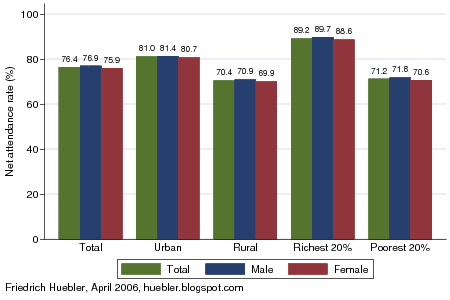
A Demographic and Health Survey (DHS) was carried out in Bolivia in 2003/04. This nationally representative household survey collected data in various areas, including education. According to the survey results, the primary school net attendance rate (NAR) is 76.4 percent. The primary school NAR is the share of children of primary school age that are attending primary school. In Bolivia, one in four children of primary school age are thus not in primary school according to the DHS.
Bolivia is not close to the Millennium Development Goal (MDG) of universal primary education, but the goal of gender parity has been reached. With 75.9 percent, the primary school NAR of girls is almost the same as that of boys, 76.9 percent. The gender parity index (GPI), the ratio of female to male NAR, is 0.99. The NAR values are shown in the graph and table below.
Primary school net attendance rate, Bolivia 2003/04
Data source: Bolivia 2003/04 DHS.
There is no gender disparity in Bolivia but disparities exist at other levels. Children in urban areas have a higher primary school NAR (81.0 percent) than children in rural areas (70.4 percent). Household wealth is strongly associated with school attendance. In the richest 20 percent of all households, 89.2 percent of all children of primary school age attend primary school. In the poorest 20 percent of all households, the primary school NAR is 71.2 percent. Raising attendance rates among the rural population and among the poor remains a challenge in Bolivia.
Primary school net attendance rate, Bolivia 2003/04
GPI: gender parity index. - Data source: Bolivia 2003/04 DHS.
Related articles
A Demographic and Health Survey (DHS) was carried out in Bolivia in 2003/04. This nationally representative household survey collected data in various areas, including education. According to the survey results, the primary school net attendance rate (NAR) is 76.4 percent. The primary school NAR is the share of children of primary school age that are attending primary school. In Bolivia, one in four children of primary school age are thus not in primary school according to the DHS.
Bolivia is not close to the Millennium Development Goal (MDG) of universal primary education, but the goal of gender parity has been reached. With 75.9 percent, the primary school NAR of girls is almost the same as that of boys, 76.9 percent. The gender parity index (GPI), the ratio of female to male NAR, is 0.99. The NAR values are shown in the graph and table below.
Primary school net attendance rate, Bolivia 2003/04
Data source: Bolivia 2003/04 DHS.
There is no gender disparity in Bolivia but disparities exist at other levels. Children in urban areas have a higher primary school NAR (81.0 percent) than children in rural areas (70.4 percent). Household wealth is strongly associated with school attendance. In the richest 20 percent of all households, 89.2 percent of all children of primary school age attend primary school. In the poorest 20 percent of all households, the primary school NAR is 71.2 percent. Raising attendance rates among the rural population and among the poor remains a challenge in Bolivia.
Primary school net attendance rate, Bolivia 2003/04
| Total NAR (%) | Male NAR (%) | Female NAR (%) | Difference male- female | GPI female/ male | |
| Urban | 81.0 | 81.4 | 80.7 | 0.7 | 0.99 |
| Rural | 70.4 | 70.9 | 69.9 | 1.0 | 0.99 |
| Richest 20% | 89.2 | 89.7 | 88.6 | 1.0 | 0.99 |
| Poorest 20% | 71.2 | 71.8 | 70.6 | 1.2 | 0.98 |
| Total | 76.4 | 76.9 | 75.9 | 1.0 | 0.99 |
Related articles
- Secondary school attendance in Bolivia
- Child labor and school attendance in Bolivia
- Child labor and school attendance in Bolivia, part 2
- Education data from household surveys
- UNICEF priority countries for girls' education
13 April 2006
Update to "Creating maps with Stata"
The guide to Creating maps with Stata has been updated. Users of Stata 9.1 or a more recent version can now convert shapefiles directly to Stata format with a new program called shp2dta. Read the guide to learn more.
Related articles
Related articles
- Creating maps with Stata
- Integrating Stata and external text editors
- Creating PNG images with Stata
- Reading Statalist with Gmail
27 March 2006
Primary completion rate 2002/03
Goal 2 of the United Nations Millennium Development Goals (MDG) is to "ensure that, by 2015, children everywhere, boys and girls alike, will be able to complete a full course of primary schooling." This site has published data for several indicators that are related to this goal, among them the primary school net enrollment ratio (NER). In countries where children begin their education at the official primary school entrance age and graduate at the official graduation age, the primary NER is a good indicator of primary school completion. If many children in a country enter school late or if repetition rates are high, on the other hand, the primary NER underestimates the participation of children in the education system. The primary completion rate has been suggested by the World Bank as a better indicator for progress toward MDG 2.
Definition: "The primary completion rate is the ratio of the total number of students successfully completing (or graduating from) the last year of primary school in a given year to the total number of children of official graduation age in the population." (United Nations Development Group. 2003. Indicators for monitoring the Millennium Development Goals: Definitions, rationale, concepts and sources. New York: United Nations.)
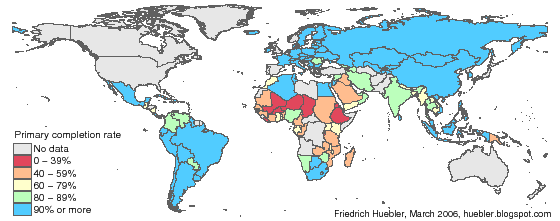
The map below indicates the primary completion rate in each country for which data was available. The top group includes all countries with a primary completion rate at or above 90 percent. The primary completion rate can have values above 100 percent, which can be a symptom of late entry, grade repetition, or of an enrollment push at some point in the past, perhaps as a consequence of a school enrollment campaign. In the UIS database, 38 countries have values above 100 percent but in the long run the primary completion rate can be expected to stabilize at 100 percent.
Primary completion rate, 2002/2003
Data source: UNESCO Institute for Statistics (UIS). 2005. Global Education Digest 2005. Montreal: UIS.
In ten countries, all in sub-Saharan Africa, the primary completion rate is below 40 percent: Burkina Faso, Burundi, Chad, Djibouti, Eritrea, Ethiopia, Guinea-Bissau, Liberia, Mali, and Niger. In 19 countries, the primary completion rate is between 40 and 59 percent, in 20 it is between 60 and 79 percent, and in 26 countries it is between 80 and 89 percent. 91 countries have primary completion rates at or above 90 percent.
The global average for the primary completion rate is 84.5 percent (see the table below). Boys (86.4 percent) are more likely to complete their primary education than girls (82.3 percent). When countries are grouped by UNICEF region, the highest primary completion rates are observed in industrialized countries (100.5 percent), Latin America and the Caribbean (97.2 percent), East Asia and the Pacific (96.6 percent), and in Eastern Europe and the Commonwealth of Independent States (93.8 percent). Countries in these regions have already reached or are close to the goal of universal primary education.
Lower primary completion rates are observed in Eastern and Southern Africa (59.5 percent), West and Central Africa (64.8 percent), the Middle East and North Africa (75.4 percent), and South Asia (81.6 percent). The biggest gender disparity exists in West and Central Africa, where the primary completion rate of boys is 14.6 percent above that of girls. High gender gaps also exist in Eastern and Southern Africa (7.6 percent), the Middle East and North Africa (7.5 percent), and South Asia (6.3 percent). Latin America and the Caribbean is the only region where girls are more likely to complete primary education than boys, but the gap is relatively small (2.6 percent).
Primary completion rate, 2002/03
Data source: UNESCO Institute for Statistics (UIS). 2005. Global Education Digest 2005. Montreal: UIS.
Note: Regional values are weighted by each country's population of primary school age.
Friedrich Huebler, 27 March 2006, Creative Commons License
Definition: "The primary completion rate is the ratio of the total number of students successfully completing (or graduating from) the last year of primary school in a given year to the total number of children of official graduation age in the population." (United Nations Development Group. 2003. Indicators for monitoring the Millennium Development Goals: Definitions, rationale, concepts and sources. New York: United Nations.)
- Primary completion rate = Number of primary school graduates / Number of children of primary school graduation age
- Gross intake rate to last grade of primary = (Number of children in last primary grade – Number of repeaters) / Number of children of entrance age to last primary grade
The map below indicates the primary completion rate in each country for which data was available. The top group includes all countries with a primary completion rate at or above 90 percent. The primary completion rate can have values above 100 percent, which can be a symptom of late entry, grade repetition, or of an enrollment push at some point in the past, perhaps as a consequence of a school enrollment campaign. In the UIS database, 38 countries have values above 100 percent but in the long run the primary completion rate can be expected to stabilize at 100 percent.
Primary completion rate, 2002/2003
Data source: UNESCO Institute for Statistics (UIS). 2005. Global Education Digest 2005. Montreal: UIS.
In ten countries, all in sub-Saharan Africa, the primary completion rate is below 40 percent: Burkina Faso, Burundi, Chad, Djibouti, Eritrea, Ethiopia, Guinea-Bissau, Liberia, Mali, and Niger. In 19 countries, the primary completion rate is between 40 and 59 percent, in 20 it is between 60 and 79 percent, and in 26 countries it is between 80 and 89 percent. 91 countries have primary completion rates at or above 90 percent.
The global average for the primary completion rate is 84.5 percent (see the table below). Boys (86.4 percent) are more likely to complete their primary education than girls (82.3 percent). When countries are grouped by UNICEF region, the highest primary completion rates are observed in industrialized countries (100.5 percent), Latin America and the Caribbean (97.2 percent), East Asia and the Pacific (96.6 percent), and in Eastern Europe and the Commonwealth of Independent States (93.8 percent). Countries in these regions have already reached or are close to the goal of universal primary education.
Lower primary completion rates are observed in Eastern and Southern Africa (59.5 percent), West and Central Africa (64.8 percent), the Middle East and North Africa (75.4 percent), and South Asia (81.6 percent). The biggest gender disparity exists in West and Central Africa, where the primary completion rate of boys is 14.6 percent above that of girls. High gender gaps also exist in Eastern and Southern Africa (7.6 percent), the Middle East and North Africa (7.5 percent), and South Asia (6.3 percent). Latin America and the Caribbean is the only region where girls are more likely to complete primary education than boys, but the gap is relatively small (2.6 percent).
Primary completion rate, 2002/03
| Region | Primary completion rate (%) | ||
| Male | Female | Total | |
| East Asia, Pacific | 96.6 | 96.6 | 96.6 |
| Eastern and Southern Africa | 63.3 | 55.7 | 59.5 |
| Eastern Europe, CIS | 96.7 | 95.4 | 93.8 |
| Industrialized countries | 100.7 | 100.7 | 100.5 |
| Latin America, Caribbean | 95.9 | 98.5 | 97.2 |
| Middle East, North Africa | 79.0 | 71.5 | 75.4 |
| South Asia | 84.6 | 78.3 | 81.6 |
| West and Central Africa | 72.0 | 57.4 | 64.8 |
| World | 86.4 | 82.3 | 84.5 |
Note: Regional values are weighted by each country's population of primary school age.
Friedrich Huebler, 27 March 2006, Creative Commons License
18 February 2006
115 million children out of school
 The number of children out of school is an important indicator to track progress toward the Millennium Development Goal of universal primary education. According to a joint report by the UNESCO Institute for Statistics and UNICEF that was published this week, 115 million children of primary school age are not in school.
The report with the title Children out of school: Measuring exclusion from primary education describes a new approach to measure the number of children out of school. Typically, the number of children out of school is based on the primary school net enrollment rate (NER), which is calculated as follows:
Primary school NER = number of children of primary school age enrolled in primary school / number of children of primary school age
The share of children out of school is assumed to be the difference between the theoretical NER at full enrollment and the current NER:
Share of children out of school = 100% - primary school NER
In many countries some children of primary school age are already attending secondary school and these children are mistakenly counted as out of school if the formula above is used. The report by UNESCO and UNICEF relies on an improved method that counts children of primary school age who are attending primary or secondary school. Children of primary school age who are still in preschool or who are in non-formal education (for example religious schools) are counted as out of school because they are not receiving the education they should get at their age.
The report also breaks new ground because it evaluates both administrative data on enrollment and attendance data from household surveys. UNESCO publications like the Global Education Digest usually only evaluate data from administrative records that are provided by national governments. Data from 80 household surveys allowed the authors to fill gaps in the administrative data and made it possible to explore the child and household characteristics associated with schooling status. The report finds, for example, that children from the poorest household quintile are three times as likely to be out of school as children from the richest quintile. A detailed appendix has statistics on children out of school for all countries. The data is mostly for the 2001/02 school year, the latest year with data at the time the report was written.
Regional distribution of children out of school, 2001/02
Data source: UNESCO Institute for Statistics (UIS). 2005. Children out of school: Measuring exclusion from primary education. Montreal: UIS. Table 1.1, page 18.
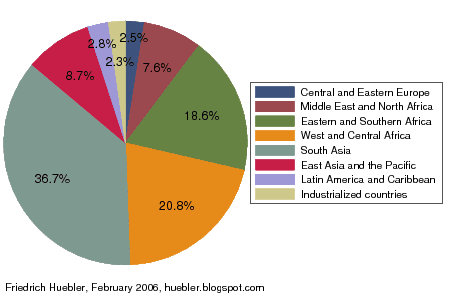
The majority of the 115 million children out of school live in Sub-Saharan Africa, as the graph above shows. 24.0 million (20.8 percent of the total) live in West and Central Africa and another 21.4 million (18.6 percent) in Eastern and Southern Africa. South Asia is home to 42.3 million or 36.7 percent of all children out of school. 10.0 million children not in school (8.7 percent) live in East Asia and 8.8 million (7.6 percent) in the Middle East and North Africa. The remaining regions have relatively high primary school enrollment rates and are therefore home to fewer children out of school. Latin America and the Caribbean contribute 3.3 million (2.8 percent) of the global population of children out of school, 2.9 million (2.5 percent) live in Central and Eastern Europe and 2.6 million (2.3 percent) in the industrialized countries. The regional groupings are those used by UNICEF (see the map in an article on regional trends in primary school enrollment).
- Download Children out of school: Measuring exclusion from primary education (PDF, 4.9 MB)
- Primary school enrollment 2002/03
- Primary school gross and net enrollment
- Regional trends in primary school enrollment
- Education data from household surveys
Subscribe to:
Posts (Atom)

