Showing posts with label attainment. Show all posts

06 March 2016

New UIS data on educational attainment and mean years of schooling

How do the world's countries compare in terms of the population's educational attainment? This question can be answered with new data by the UNESCO Institute for Statistics (UIS), released in February 2016. The UIS Data Centre lists data for three indicators:

All three indicators are available for the total, male and female population. The first two indicators are presented for the levels of education defined in the International Standard Classification of Education (ISCED):

  • Primary education (ISCED 1)
  • Lower secondary education (ISCED 2)
  • Upper secondary education (ISCED 3)
  • Post-secondary non-tertiary education (ISCED 4)
  • Short-cycle tertiary education (ISCED 5)
  • Bachelor's degree or equivalent (ISCED 6)
  • Master's degree or equivalent (ISCED 7)
  • Doctoral degree or equivalent (ISCED 8)

The table on the highest completed level of education in the UIS Data Centre also presents the percentage of the population that has no formal schooling and that has incomplete primary education.

For the first time, the UIS is offering time series with data on educational attainment, covering the years 1995 to 2015. Previously, data on the highest and minimum completed level of education were only available for the most recent year. In total, educational attainment data are available for 147 countries and territories. The number of countries with data for a given year is shown in Figure 1. For example, 74 countries have data for 2010 and one country (Mali) has data for 2015. Portugal has data for 17 years, South Africa has data for 11 years, other countries have data for fewer years. 35 countries have data for only 1 year.

Figure 1: Number of countries with data on educational attainment in UIS Data Centre per year

Data source: UNESCO Institute for Statistics

Estimates of mean years of schooling, i.e. the average number of completed years of education, are derived from data on educational attainment and were first released by the UIS in December 2013. The estimates were updated in March 2015 and then again with the most recent release, in February 2016. The UIS Data Centre now presents mean years of schooling for 149 countries and territories for the period 1970 to 2014. Figure 2 shows the number of countries with data on mean years of schooling per year. 53 countries have data for 2010, more than any other year. The countries with the best coverage are South Africa with data on mean years of schooling for 16 years, Spain with data for 13 years, and Mexico with data for 11 years. 45 countries have data for only 1 year.

Figure 2: Number of countries with data on mean years of schooling in UIS Data Centre per year

Data source: UNESCO Institute for Statistics

External links

Related articles

Friedrich Huebler, 6 March 2016, Creative Commons License
Permanent URL: http://huebler.blogspot.com/2016/03/ea.html

31 May 2015

Mean years of schooling in Nepal

On 25 April 2015, Nepal was struck by a severe earthquake that killed more than 8,800 people. Nepal is one of the world's poorest countries, with a gross national income (GNI) per capita of US$730 in 2013, similar to Afghanistan and Burkina Faso. Of 187 countries on the Human Development Index (HDI) 2014, Nepal was at position 145.

The rank of Nepal on the HDI is partly determined by the low level of education of its population. According to the Human Development Report 2014, the population 25 years and older of Nepal had on average 3.2 years of schooling in 2012.

This article takes a closer look at the level of education of the population of Nepal, based on an analysis of data from a 2011 Demographic and Health Survey (DHS). The DHS collected information on the highest grade of school completed for all household members 3 years and older, which can be used to calculate the years of schooling of individuals and the average years of schooling of the entire population or specific sub-groups. According to the DHS data, the population 25 years and older in Nepal has on average 3.3 years of schooling (Figure 1). The duration of primary education in Nepal is 5 years, which means that the average adult 25 years and older has less than completed primary education.

Urban residents have nearly twice as many years of schooling as rural residents, with 5.7 and 2.9 years respectively. There is a strong correlation between mean years of schooling and household wealth. Persons 25 years and older from the poorest household quintile have only 1.1 years of schooling on average, compared to 6.6 years in the richest quintile.

Figure 1: Mean years of schooling, population 25 years and older, Nepal 2011

Data source: Nepal Demographic and Health Survey, 2011.

Figure 1 also presents data for the development regions and ecological zones of Nepal. The country is administratively divided into five development regions (Far-Western, Mid-Western, Western, Central, and Eastern), 14 administrative zones, and 75 districts. The country is also divided into three ecological zones: Mountain, Hills and Terai. The development regions and ecological zones are shown in Figure 2. The epicenter of the April 2015 earthquake was in the Lamjung district in the Western development region. The capital Kathmandu, which was also severely affected by the earthquake, is in the Central development region.

The population in the Far-Western and Western development regions has 2.6 mean years of schooling, below the national average of 3.3 years. The population of the Western, Central and Eastern development regions is at or slightly above the national average. Residents of the Mountain zone have on average 2.2 years of schooling, while those in the Hill and Terai zone have 3.5 and 3.3 years, respectively.

Gender disparity in educational attainment affects all regions and sub-groups of the population in Figure 1. At the national level, women 25 years and older have only 2.2 years of schooling on average, compared to 4.6 years among men. There is a large gap between the mean years of schooling of men and women in both rural and urban areas of Nepal. Women from the poorest household quintile have only 0.5 mean years of schooling, less than any other group in Figure 1; men in the poorest quintile have 1.9 years of schooling. In the richest quintile, women have on average 6.2 years of schooling, compared to 8.1 years for men. Gender disparity is also present in all development regions and ecological zones.

Figure 2: Development regions, districts, and ecological zones of Nepal

Source: United Nations Nepal Information Platform, retrieved May 2015.

A comparison of different age groups reveals that in spite of the low average years of schooling Nepal has made impressive progress over the past decades. Younger cohorts have without exception more years of schooling than older cohorts (Figure 3). 20- to 24-year-olds have on average 6.9 years of schooling, compared to less than 1 year of schooling among those 65 years and older. In rural areas those 20-24 years old have on average 6.5 years of schooling and those in urban areas 8.5 years. The poorest residents of Nepal are still very much behind those from wealthier segments of the population but even here there has been an improvement among younger generations. 20- to 24-year-olds from the poorest quintile have on average 3.6 years of schooling. In the richest quintile, those aged 20-24 years have 9.6 years of schooling on average, more than any other group in Figure 3.

Figure 3: Mean years of schooling by age group, Nepal 2011

Data source: Nepal Demographic and Health Survey, 2011.

The disparity between women and men in younger cohorts is also far smaller than among older cohorts. Figure 4 shows two indicators of gender disparity. The difference between the mean years of schooling of men and women is plotted against the left vertical axis. Nationwide, 20- to 24-year-old women have on average 1.9 fewer years of schooling than men in the same age group.The biggest absolute gap is observed in the poorest household quintile; here, women 20-24 years have on average 2.8 fewer years of schooling than men. The smallest difference between male and female years of schooling, 0.7 years, is observed among 20- to 24-year-olds in the richest quintile.

A second indicator of gender disparity, female mean years of schooling as a percentage of male mean years of schooling, is plotted against the right vertical axis of Figure 4. At gender parity, this value is around 100%. In all groups in Figure 4, younger women are approaching the average years of schooling of men in the same age group. In Nepal as a whole, 20- to 24-year-old women have on average 76% of the years of schooling of their male peers. In the richest quintile, the youngest women have reached 93% of the years of schooling of men in the same age group. By contrast, young women from the poorest household quintile have only half the years of schooling of young men.

Over time, the increasing educational attainment among younger age groups will be reflected in the mean years of schooling of the entire population 25 years and older. Similarly, the gap between men and women will shrink. However, those in poor households and residents of certain regions - especially the Far-Western and Mid-Western region and the mountain zone - are lagging behind other parts of Nepal.

Figure 4: Gender disparity in mean years of schooling by age group, Nepal 2011

Data source: Nepal Demographic and Health Survey, 2011.

External links

Related articles

Friedrich Huebler, 31 May 2015, Creative Commons License
Permanent URL: http://huebler.blogspot.com/2015/05/nepal.html

31 January 2014

Mean years of schooling in Burkina Faso

In Burkina Faso, the population aged 25 years and older had on average 0.9 years of education in 2007, less than any other country for which the UNESCO Institute for Statistics (UIS) released estimates of mean years of schooling in December 2013.

The educational attainment of different age cohorts in Burkina Faso can also be examined with data from a Demographic and Health Survey (DHS) conducted in 2010. On average, persons aged 25 years and older in the DHS sample attended school for 1.4 years, slightly more than in the UIS data from 2007. The DHS data show a significant gender gap, with men having on average nearly twice as many years of schooling as women (1.9 years versus 1 year).

However, the disparity between men and women in Burkina Faso is not nearly as large as the disparity between the urban and rural population. In urban areas, the average number of years of education is 4.1 years, compared to 0.5 years in rural areas. Urban women have 11 times as many years of schooling as rural women (3.3 years versus 0.3 years). For men, mean years of schooling is 5.0 in urban areas and 0.7 in rural areas.

Mean years of schooling of the population 25 years and older, Burkina Faso, 2010
Total Male Female
Total 1.4 1.9 1.0
Urban 4.1 5.0 3.3
Rural 0.5 0.7 0.3
Source: Burkina Faso Demographic and Health Survey 2010.

The DHS data can also be used to compare the educational attainment of different age groups. The figure below visualizes mean years of schooling by five-year age group, from persons aged 20-24 years to those aged 70-74 years and 75 years and older. The graph is divided into nine segments with data for the total, male and female population of Burkina Faso, as well as the total, male and female population of urban and rural areas of the country. The blue line in each segment indicates the mean years of schooling by age group for the respective population group. In addition, each segment of the graph shows the lines for the other eight segments in light gray to make it easier to compare the data for the different groups.

One common feature across all population groups is that younger generations have more formal schooling than older generations, reflecting an expansion of access to education over time. In the total population, mean years of schooling increased from 0.1 years among those 75 years and older to 2.9 years among 20- to 24-year-olds. The biggest growth is observed among urban men: for this group, mean years of schooling is 0.8 years in the oldest cohort and 7.2 years among those aged 20-24 years. Rural women have traditionally been least likely to attend school but even here there is an upward trend: rural women 75 years and older have on average 0 years of schooling whereas rural women aged 20-24 years have on average 0.9 years of schooling.

In conclusion, although the average level of education in Burkina Faso is very low, the situation is improving over time because children are more likely to attend school today than in previous decades. At the same time, the population of rural areas continues to be at a distinct disadvantage and lack of access to education is especially widespread among rural women.

Mean years of schooling by five-year age group, Burkina Faso, 2010 (click image to enlarge)

Source: Burkina Faso Demographic and Health Survey 2010.

External links

Related articles

Friedrich Huebler, 31 January 2014 (edited 4 February 2014), Creative Commons License
Permanent URL: http://huebler.blogspot.com/2014/01/mys.html

28 December 2013

Mean years of schooling

Mean years of schooling (MYS), the average number of completed years of education of a population, is a widely used measure of a country's stock of human capital. Since 2010, MYS is used as one of two education indicators (the second education indicator is the school life expectancy) in the calculation of the Human Development Index (HDI) (UNDP, 2010).

A well-known data set with estimates of MYS was developed by Robert Barro and Jong-Wha Lee, two pioneers in this field of work. In 1993, Barro and Lee published an article describing their data set, which was partly derived from data on educational attainment by the Division of Statistics of UNESCO. Barro and Lee continue to update their data set, which is available at their website.

In December 2013, the UNESCO Institute for Statistics (UIS), the successor of the Division of Statistics of UNESCO, published its first estimates of MYS of the population aged 25 years and older. This indicator, used in the calculation of the HDI, had previously not been available in the database of the UIS. The UIS methodology is based on the approach by Barro and Lee. There are still important gaps in the UIS database but the UIS will attempt to fill them in the coming years.

The figure below summarizes the MYS estimates released by the UIS in December 2013. The UIS provides data for 103 countries and territories from the period 1996 to 2013. In the figure, only the latest available data are shown for each country. All countries are grouped by geographic region and sorted by MYS of the total population. As noted above, there are large gaps in the UIS database. For example, MYS estimates are only available for 13 of the 45 countries in sub-Saharan Africa. For two thirds of all countries, the MYS estimates are from 2007 or a later year but for the remaining countries, the most recent estimates are more than 6 years old. In spite of these gaps, some interesting patterns can be observed in the data.

MYS is highest (generally 8 years or more) in North America and Western Europe, Central Asia, and Central and Eastern Europe. Among the countries with data, the highest MYS was calculated for the United Kingdom in 2011: 13.8 years. By contrast, MYS values are lowest in sub-Saharan Africa and South Asia. In Burkina Faso, men and women 25 years and older completed on average less than one year of schooling.

Gender disparities, indicated by the difference between male and female MYS, are smallest in North America and Western Europe and in Central Asia, and largest in sub-Saharan Africa and in South and West Asia. In Pakistan, adult men had on average completed 3 more years of schooling than adult women in 2011 (6.2 years for men versus 3.1 years for women). In East Asia and the Pacific and in sub-Saharan Africa, the spread between the countries with the lowest and highest MYS is more than 10 years. In the Arab States, Central and Eastern Europe, Central Asia, and North America and Western Europe, the difference between the countries with the lowest and highest MYS is 6 years or less.

Mean years of schooling of the population 25 years and older, latest year available (click image to enlarge)

Note: Countries in each region sorted by MYS of total population.
Source: UIS Data Centre, December 2013, http://stats.uis.unesco.org.

The full data set with UIS estimates of MYS is available in the UIS Data Centre. The data set lists MYS values for the total, male and female population 25 years and older of 103 countries and territories, as well as the educational attainment data on which the MYS estimates are based.

  • Go to the UIS Data Centre at http://stats.uis.unesco.org.
  • Click on "Predefined Tables".
  • Click on "Literacy and Educational Attainment".
  • Click on "Mean years of schooling of population aged 25 years and older" to download an Excel file with all data.

References

External links

Related articles

Friedrich Huebler, 28 December 2013, Creative Commons License
Permanent URL: http://huebler.blogspot.com/2013/12/mys.html

26 February 2012

Educational attainment in sub-Saharan Africa

The educational attainment of a country's adult population reflects long-run trends in participation in primary, secondary and post-secondary education. Educational attainment is a measure of human capital - the skills and competencies of the population - and thus an indicator of a country's potential for economic growth. Educational attainment is also closely linked to health, political participation, and other indicators of social development.

Compared to other regions, educational attainment in sub-Saharan Africa is relatively low but there are large variations between individual countries. The graph and table below present data from the UNESCO Institute for Statistics (UIS), published in the Global Education Digest 2011. The values for each country indicate which percentage of the population aged 25 years and older completed at least primary, lower secondary, upper secondary, post-secondary, or tertiary education. For example, in Seychelles, 90% of the adult population completed at least primary education, 67% at least lower secondary education, and 44% at least upper secondary education. At the other end of the distribution is Burkina Faso, where only 5% of the adult population completed at least primary education and only 2% at least lower secondary education.

Sub-Saharan Africa: Population 25 years and older by minimum level of education
Graph with educational attainment in sub-Saharan Africa
Source: UNESCO Institute for Statistics, Global Education Digest 2011, Table 19. - Click image to enlarge.

Among the 15 countries in sub-Saharan Africa for which UIS has data, only seven - Kenya, Mauritius, Namibia, Seychelles, South Africa, Tanzania, and Zimbabwe - have attainment rates for primary education at or above 50%. In the remaining eight countries with data - Benin, Burkina Faso, Chad, Lesotho, Malawi, Mali, Senegal, and Uganda - less than half of the population 25 years and older completed at least primary education. For Benin, the share of the population with completed primary education is unknown because the country reported combined figures for incomplete and complete primary education; 16% of the population attended primary education with or without completing that level (see Global Education Digest 2011, Table 18).

Similar to the attainment rates for primary education, attainment rates for other levels of education also vary widely between individual countries. The proportion of the population that completed at least lower secondary education ranges from 2% in Burkina Faso to 70% in South Africa. For upper secondary education, the attainment rates range from 0.5% in Burkina Faso to 44% in Seychelles. Not more than 0.5% of the adult population completed post-secondary education in Burkina Faso and Malawi, compared to 12% in South Africa. Completed tertiary education is uncommon among the population 25 years and older in sub-Saharan Africa. Only one country, Seychelles, has an attainment rate for tertiary education greater than 3%.

Sub-Saharan Africa: Population 25 years and older by minimum level of education
Country Year Level of education (%)
Primary Lower secondary Upper secondary Post- secondary Tertiary
Benin 2002
.
14.3
.
2.2
2.2
Burkina Faso 2007
5.2
2.0
0.5
0.3
0.2
Chad 2004
8.5
5.5
.
3.2
3.2
Kenya 2010
59.4
41.9
36.3
6.3
0.0
Lesotho 2008
40.9
20.9
13.8
5.4
1.9
Malawi 1998
19.8
8.6
5.2
0.5
0.5
Mali 2006
18.6
10.3
5.5
1.9
1.9
Mauritius 2000
48.9
38.9
20.3
7.9
2.6
Namibia 2001
48.5
27.7
17.0
5.3
2.2
Senegal 2006
10.7
7.5
4.9
3.2
0.8
Seychelles 2002
90.3
66.8
44.2
.
7.4
South Africa 2009
76.4
70.4
35.7
11.8
0.7
Tanzania 2002
48.9
6.0
1.6
.
0.9
Uganda 2008
34.6
23.4
8.7
6.8
1.8
Zimbabwe 2002
65.1
45.9
10.3
9.1
1.5
Source: UNESCO Institute for Statistics, Global Education Digest 2011, Table 19.

When interpreting the educational attainment data for sub-Saharan Africa it is necessary to consider that the reported values for some countries are more than a decade old. As younger, more educated cohorts reach age 25, the average attainment rates of the population 25 years and older increase and the situation of some countries is therefore likely to have improved since the year of reporting. In addition, the picture is incomplete because for 30 of the 45 countries in the sub-Saharan Africa region, as defined by UIS, no educational attainment data is available in the UIS Data Centre.

Reference

  • UNESCO Institute for Statistics (UIS). 2011. Global Education Digest 2011: Comparing Education Statistics Across the World. Montreal: UIS. (Download in PDF format, 7.5 MB)
External links

Related articles

Friedrich Huebler, 26 February 2011, Creative Commons License
Permanent URL: http://huebler.blogspot.com/2012/02/ssa.html

03 January 2011

Educational attainment in the United States, 1940-2009

In the United States, the level of education of the adult population has increased steadily since the middle of the 20th century. The share of the population 25 years and over who attended college increased from 10 percent in 1940 to 56 percent in 2009. 30 percent of the population in this age group had completed 4 or more years of college in 2009. The share of the population with only elementary education or no formal schooling fell from 60 percent in 1940 to 6 percent in 2009. High school reached its peak as the most common level of education in the 1970s and 1980s, with a share around 50 percent, but younger cohorts are more likely to continue their education at the post-secondary level.

This increase in educational attainment of the work force has contributed to a strengthening of U.S. competitiveness in the global economy. At the same time, the increased demand for highly skilled workers emphasizes the importance of secondary and higher education for individuals in search of employment.

The trends in years of schooling of the adult U.S. population from 1940 to 2009 are visualized in the figure below. The table that follows lists data for selected years. The data on educational attainment were collected with the Current Population Survey (CPS), a joint survey by the Bureau of Labor Statistics and the Census Bureau that has been conducted since 1940.

Years of school completed by population 25 years and over, 1940-2009
Graph with trends in educational attainment in the United States from 1940 to 2009
Source: U.S. Census Bureau, September 2010

Years of school completed by population 25 years and over, 1940-2009
Years of school Percent of population
1940 1950 1960 1970 1980 1990 2000 2009
0 to 4 years elementary school 13.5 10.8 8.3 5.3 3.4 2.4 1.6 1.4
5 to 8 years elementary school 46.0 36.1 31.4 22.4 14.1 8.8 5.4 4.1
1 to 3 years high school 15.0 16.9 19.2 17.1 13.9 11.2 8.9 7.9
4 years high school 14.1 20.1 24.6 34.0 36.8 38.4 33.1 31.1
1 to 3 years college 5.4 7.1 8.8 10.2 14.9 17.9 25.4 26.1
4 or more years college 4.6 6.0 7.7 11.0 17.0 21.3 25.6 29.5
Source: U.S. Census Bureau, September 2010

Data source
Related articles
External links
Friedrich Huebler, 3 January 2011, Creative Commons License
Permanent URL: http://huebler.blogspot.com/2011/01/usa.html

24 January 2009

Educational attainment in Brazil since 1920

Brazil is likely to reach the Millennium Development Goal of universal primary education by 2015. According to the UNESCO Institute for Statistics (UIS), 94 percent of all children of primary school age (7 to 10 years) were enrolled in primary school in 2005. Data from the 2006 National Household Sample Survey (Pesquisa Nacional por Amostra de Domicílios, PNAD), analyzed in an article on school attendance in Brazil, show that 99 percent of all children between 7 and 10 years were in pre-primary, primary or secondary education.

PNAD data can also be used to demonstrate how the education system in Brazil has expanded over the past decades. The PNAD survey collected information on the highest level of education attended for all persons in the sample. By comparing the highest level of education of persons born in different years it is possible to show the change in school attendance patterns over time. The following graph displays the highest level of education for persons born between 1920 and 2000. Household members born in 2000 were 5 or 6 years old at the time of the survey in 2006.

Highest level of education attended by year of birth, Brazil 1920-2000
Data source: Brazil National Household Sample Survey (PNAD), 2006.

Only 59 percent of all Brazilians born in 1920 ever attended school, and three out of four persons who attended school never went beyond primary education. Primary, secondary and tertiary school attendance rates increased steadily over the following decades. By the 1960s, nine out of ten Brazilians were able to receive a formal education. 91 percent of all persons born in 1960 attended at least primary school, 58 percent in this age group attended at least secondary school, and 14 percent went to a university.

The expansion of the primary education system began to slow down in the 1960s, after it had already reached a high level of coverage, but secondary school attendance rates continued to grow at a rapid pace. Among persons born in 1990, 98 percent attended primary school and 90 percent attended secondary school. Among persons born in 1994, 99 percent attended primary school. The peak value for participation in secondary education is 91 percent for persons born in 1988.

Fewer Brazilians have tertiary education, but almost one fifth of the population born around 1980 had attended a university or other institution of higher education by the time the PNAD survey was conducted in 2006. The peak value for participation in tertiary education is 19 percent for persons born in 1981.

Data sources
  • Brazilian Institute of Geography and Statistics (IBGE), National Household Sample Survey (Pesquisa Nacional por Amostra de Domicílios, PNAD), 2006
  • UNESCO Institute for Statistics (UIS), Data Centre, January 2009
Related articles
External links
Friedrich Huebler, 24 January 2009, Creative Commons License
Permanent URL: http://huebler.blogspot.com/2009/01/brazil.html

10 October 2005

Educational attainment in India, 1950-2000

India is well on the way to achieving the Millennium Development Goal of universal primary education by the year 2015. In spite of rapid population growth during the last 50 years, India has managed to expand its education system to reach an ever larger part of the population.

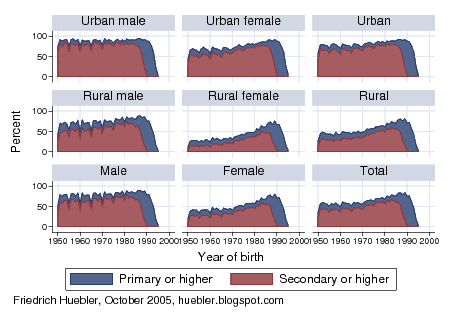
The increase in educational attainment since 1950 can be traced with data from a Multiple Indicator Cluster Survey (MICS) that was conducted in India in 2000. This nationally representative household survey collected data on the education of all household members aged 5 years or older. The data indicates whether a person attended school, at which level, and for how many years. By grouping all household members by year of birth we can calculate the percentage of a cohort that has attended - but not necessarily completed - a certain level of education. The graph below plots these values for all persons born between 1950 and 2000, disaggregated by sex and area of residence.

Educational attainment by year of birth, India 1950-2000
Chart with educational attainment (primary, secondary or higher) by year of birth, India 1950-2000
Data source: India 2000 MICS.

For each cohort two values are shown:
  • the percentage who attended primary school or higher (blue area)
  • the percentage who attended secondary school or higher (red area)
Until the 1970s, attendance rates for the population as a whole remained stable. About 55% of the population born between 1950 and 1970 attended primary school or higher. For persons born around 1990, this value has increased to roughly 80%.

School attendance rates were historically highest among urban males. Already in the 1950s, 90% of this group attended school at the primary level or higher. In contrast, the most disadvantaged group are women living in rural India. In the 1950s, only 25% of this group attended at least primary school. Women born since the 1970s are much more likely to benefit from education. The percentage of rural women who attended primary school or higher has increased from about 30% in the 1960s to about 70% in the 1990s.

Secondary school attendance rates have increased at a similar pace but at a lower lever. Most children who attend primary school continue their education at the secondary level. In 2000, the primary school net attendance rate in India overall was estimated to be 75% for boys and 69% for girls. The secondary school net attendance rate was estimated to be 54% for boys and 46% for girls. There has been much progress toward gender equality over the last 50 years but women and girls are still disadvantaged in Indian society.

Related articles
Friedrich Huebler, 10 October 2005 (edited 12 October 2008), Creative Commons License
Permanent URL: http://huebler.blogspot.com/2005/10/educational-attainment-in-india-1950.html

12 September 2005

Poverty and educational attainment in the United States, part 2

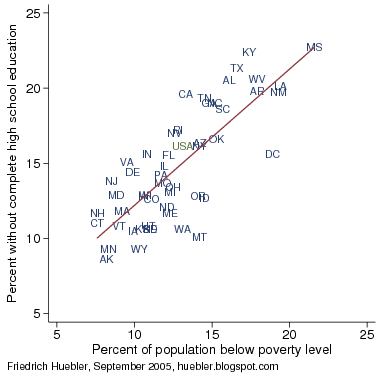
Poverty and education are closely linked. In India, for example, children from the poorest households are least likely to attend primary school. Such a link between poverty and education also exists in industrialized countries. In the United States, the states with the highest poverty rates are also those with the lowest share of high school graduates. The graph below plots the percent of the population living below the poverty level against the percent of the population above 25 years of age without complete high school education. The data is from the 2004 American Community Survey and all states are marked with their U.S. postal abbreviation.

Percent of population below poverty level and percent of population 25 years and over who did not graduate from high school, United States 2004
Scatter plot with percent of population below poverty level and percent who did not complete high school, United States 2004
Data source: 2004 American Community Survey.

The regression line emphasizes the close link between poverty and lack of education in the United States. Mississippi has the poorest and least educated population, with 22 percent living below the poverty level and 23 percent not having graduated from high school. Other states with a low share of high school graduates and high poverty rates are Alabama, Arkansas, Kentucky, Louisiana, New Mexico, Texas, and West Virginia. In contrast, Alaska, Connecticut, Minnesota, and New Hampshire have the least poor and most educated population in the United States. In the country as a whole, 13 percent of the population live below the poverty level and 16 percent did not graduate from high school.

Related articles
Friedrich Huebler, 12 September 2005 (edited 9 May 2009), Creative Commons License
Permanent URL: http://huebler.blogspot.com/2005/09/poverty-and-educational-attainment-in_12.html

04 September 2005

Poverty and educational attainment in the United States

On August 29, 2005, hurricane Katrina, possibly the deadliest storm in U.S. history, caused extensive damage in the southeastern United States. The victims of Katrina tended to be black, poor and less educated and many did not have the means to leave the area before the storm arrived.

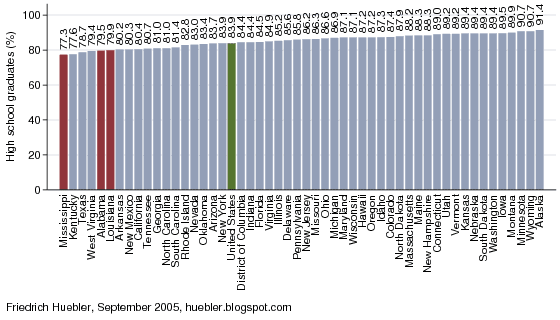
Alabama, Louisiana and Mississippi, the states that were particularly hard hit, are among the poorest in the nation, according to data from the 2004 American Community Survey by the U.S. Census Bureau. In Mississippi, 21.6% of the population lived below the poverty line, more than in any other U.S. state. Louisiana was the second poorest state, with 19.4% of the population living below the poverty line. Alabama was the ninth poorest of the 50 states, with 16.1% below the poverty line. New Orleans, the city with the highest number of storm victims, had a poverty rate of 23.2%. In comparison, 13.1% of the entire U.S. population lived below the poverty line in 2004. In terms of education, the three states affected most by the hurricane also rank near the bottom of the 50 U.S. states, as the graph below shows.

Percent of population 25 years and over who graduated from high school, United States 2004
Bar chart with percent of population who completed high school, United States 2004
Data source: 2004 American Community Survey.

The 2004 American Community Survey found that 83.9% of the U.S. population aged 25 years and over graduated from high school, which means that they have at least 12 years of education. In the graph above, the states are ranked by the share of the population who completed high school. Mississippi had the lowest percentage of high school graduates, 77.3%. Alabama with 79.5% and Louisiana with 79.9% rank fifth and sixth in terms of the lowest share of high school graduates.

The victims of hurricane Katrina are mostly from the margins of U.S. society, poor, with little education and limited economic opportunities. Local, state and national government agencies have the responsibility to assist those in need but there has been widespread criticism of the government's slow response to the disaster. Many survivors have lost their homes and other belongings and are unable to provide for themselves. They will depend on help from the government and charitable organizations like the Red Cross for many months and years to come.

Related articles
Friedrich Huebler, 4 September 2005 (edited 9 May 2009), Creative Commons License
Permanent URL: http://huebler.blogspot.com/2005/09/poverty-and-educational-attainment-in.html