Showing posts with label Bolivia. Show all posts

31 July 2006

Child labor and school attendance in Bolivia, part 2

Child labor interferes with school attendance and is therefore an obstacle to the Millennium Development Goal of universal primary education. In Bolivia, 90 percent of all children between 5 and 14 years of age attend school. At the same time, one third of all children in this age group are engaged in child labor, as shown in a previous post on child labor and school attendance in Bolivia.

For the purpose of this analysis, child labor is defined as any economic activity during the week of the survey, or more than two hours of household chores per day. The data for Bolivia were collected in a Multiple Indicator Cluster Survey (MICS) in 2000. The previous post presented the data on child labor and schooling disaggregated by age group, sex, area of residence, and household wealth. Today's article will take a closer look at the pattern of work and school attendance by age.

The graph belows present the share of children aged 5 to 14 years who attend school or are engaged in child labor. School attendance is defined as attending any level of education at the time of the MICS survey. Each point represents children of a single age, from 5 years, 6 years, and so on, to 14 years of age. Child labor rates are plotted against the horizontal axis, school attendance rates against the vertical axis.

Child labor and school attendance by age, children 5-14 years, Bolivia
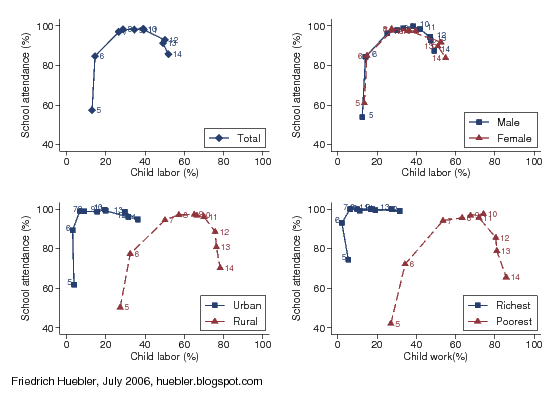
Scatter plot with child labor and school attendance rates by age, Bolivia 2000
Data source: Bolivia 2000 MICS.

The upper left quadrant shows the values for all children combined. The inverted U shape indicates that children work steadily more as they grow older, while school attendance rates reach a peak near 100 percent for children between 7 and 11 years of age and then decrease again. The upper right quadrant, with data disaggregated by gender, makes clear that there is no difference between boys and girls in Bolivia, as far as work and school are concerned.

There are, however, big differences between children from urban and rural areas, as the lower left quadrant shows. Among urban children, school attendance rates rise rapidly with age and at 7 years, 99 percent of all children are in school. Few children drop out as they grow older and among 14-year-olds, the school attendance rate is still 95 percent. In rural areas, school attendance rates for children between 7 and 11 years of age are also above 90 percent.

Compared to urban children, rural children are much more likely to be engaged in child labor. The highest child labor rate in urban areas is observed for children 14 years old (36 percent). In contrast, one third of all 6-year-olds (32 percent) and half of all 7-year-olds (50 percent) do child labor. Child labor rates continue to increase with age and at 14 years, 78 percent of all rural children work, compared to 70 percent in this age group who attend school.

The last graph, in the lower right quadrant, compares children from the richest and poorest 20 percent of all households. The overall pattern is very similar to that for urban and rural children. Children from wealthy households are much more likely to attend school and less likely to work than children from poor households. In the richest household quintile, school attendance rates are between 99 and 100 percent for all children aged 7 to 14 years, while child labor rates do not exceed 32 percent. In the poorest household quintile, the child labor rate reaches 86 percent among 14-year-old children. 66 percent of 14-year-olds from the poorest household are in school.

A comparison of the individual graphs makes clear that the overall pattern of child labor and school attendance in Nepal is strongly influenced by children from poor, rural households. Many of these children work and do not complete their education.

Related articles
Friedrich Huebler, 31 July 2006 (edited 5 October 2008), Creative Commons License
Permanent URL: http://huebler.blogspot.com/2006/07/child-labor-and-school-attendance-in.html

29 June 2006

Child labor and school attendance in Bolivia

Previous posts presented data on primary and secondary school attendance in Bolivia, one of UNICEF's 25 priority countries for girls' education. With a primary school net attendance rate of 76.4 percent, Bolivia is not close to the Millennium Development Goal of a full course of primary schooling for all children by 2015. There are several obstacles on the way to universal primary education and one of these obstacles is child labor.

Child labor can harm a child's health and, even if not harmful, it can interfere with school attendance. The latest data on school attendance for Bolivia comes from a Demographic and Health Survey (DHS) conducted in 2003/04. The DHS did not collect data on work by children but such data is available from a Multiple Indicator Cluster Survey (MICS) that was carried out in 2000.

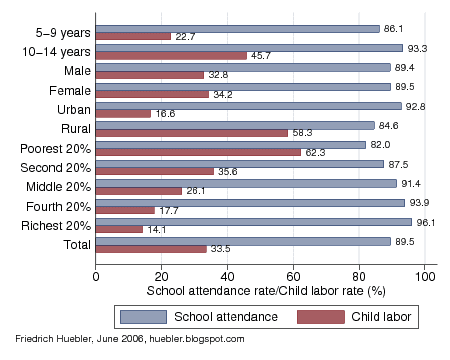
The graph and table below present the share of children aged 5 to 14 years who attend school or are engaged in child labor. School attendance is defined as attending any level of education at the time of the MICS survey, from preschool over primary to secondary school. Child labor is defined as any economic work during the week of the survey, or more than two hours of domestic work per day. Economic work includes paid or unpaid work for someone who is not a member of the household, and paid or unpaid work for a family farm or business. Domestic work covers activities like cleaning, cooking, shopping, or caring for other children.

School attendance and child labor, children 5-14 years, Bolivia
Bar chart with school attendance and child labor rates in Bolivia, 2000
Data source: Bolivia 2000 MICS.

In total, 89.5 percent of all children between 5 and 14 years are in school and 33.5 percent are engaged in child labor. Older children are more likely to go to school or work than younger children. There is no difference between boys' and girls' school attendance rates but slightly more girls are engaged in child labor. There are clear differences between children from urban and rural areas, especially with regard to child labor. 92.8 percent of all urban children go to school and only 16.6 percent are in child labor. In rural areas, 84.6 percent are in school and more than half of all children, 58.3 percent, are child laborers.

There is also a clear association between household wealth and school or work. Of all groups, children from the poorest 20 percent of all households have the lowest school attendance and highest child labor rates: 82.0 percent are in school and 62.3 percent at work. In contrast, children from the richest 20 percent of all households are most likely to be in school and least likely to work: 96.1 percent of these children attend school and only 14.1 are engaged in child labor. School attendance rates increase steadily with household wealth, while child labor rates decrease.

School attendance and child labor, children 5-14 years, Bolivia 2000

School attendance (%)Child labor (%)
5-9 years86.122.7
10-14 years93.345.7
Male89.432.8
Female89.534.2
Urban92.8
16.6
Rural84.658.3
Poorest household quintile82.062.3
Second household quintile87.535.6
Middle household quintile91.426.1
Fourth household quintile93.917.7
Richest household quintile96.114.1
Total89.533.5
Data source: Bolivia 2000 MICS.

Related articles
Friedrich Huebler, 29 June 2006 (edited 5 October 2008), Creative Commons License
Permanent URL: http://huebler.blogspot.com/2006/06/child-labor-and-school-attendance-in.html
27 May 2006

Secondary school attendance in Bolivia

Bolivia is one of UNICEF's 25 priority countries for girls' education. The primary school net attendance rate (NAR) is 76.4 percent, according to results of a Demographic and Health Survey (DHS) from 2003/04. This means that three out of four children of primary school age are in primary school.

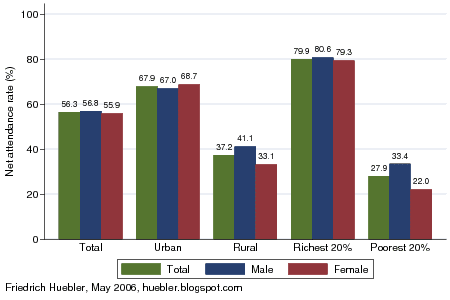
Fewer children continue their education at the secondary level. Overall, the secondary school NAR is 56.3 percent according to the DHS, but attendance rates are much higher in urban areas and among the richest households (see the graph below). In the richest 20 percent of all households, 79.9 percent of all children of secondary school age are in secondary school. In urban areas of Bolivia, the secondary school NAR is 67.9 percent. The lowest attendance rate, 27.9 percent, is observed among the poorest 20 percent of all households. In other words, more than seven out of ten children from the poorest households do not attend secondary school. In rural areas the secondary NAR is 37.2 percent.

Secondary school net attendance rate, Bolivia 2003/04
Bar chart with total, male and female secondary school net attendance rate in Bolivia, 2003/04
Data source: Bolivia 2003/04 DHS.

In Bolivia overall, there is gender parity at the secondary level of education. The gender parity index (GPI), the ratio of the female to the male NAR, is 0.98, as shown in the following table. In primary school, gender parity exists regardless of the area of residence and the level of household wealth, but this is not the case at the secondary level of education. In rural areas and among the poorest households, boys are much more likely to attend secondary school than boys. The GPI in rural areas is 0.81 and among the poorest 20 percent of all households it is as low as 0.66, which means that for every three boys only two girls are in secondary school. To reach the Millennium Development Goal of gender parity at all levels of education, it is necessary to bring more girls from poor and rural households into school.

Secondary school net attendance rate, Bolivia 2003/04

Total
NAR (%)
Male NAR (%)Female NAR (%)Difference
male- female
GPI
female/ male
Urban67.967.068.7-1.71.03
Rural37.241.133.18.00.81
Richest 20%79.980.679.31.30.98
Poorest 20%27.933.422.011.40.66
Total56.356.855.91.00.98
GPI: gender parity index. - Data source: Bolivia 2003/04 DHS.

Related articles
Friedrich Huebler, 27 May 2006 (edited 30 June 2006), Creative Commons License

16 April 2006

Primary school attendance in Bolivia

Bolivia, one of the poorest nations in Latin American, is the only country from that region among UNICEF's 25 priority countries for girls' education. In 2005, the population of Bolivia was estimated at 9.1 million, including 1.4 million children of primary school age (6 to 11 years).

A Demographic and Health Survey (DHS) was carried out in Bolivia in 2003/04. This nationally representative household survey collected data in various areas, including education. According to the survey results, the primary school net attendance rate (NAR) is 76.4 percent. The primary school NAR is the share of children of primary school age that are attending primary school. In Bolivia, one in four children of primary school age are thus not in primary school according to the DHS.

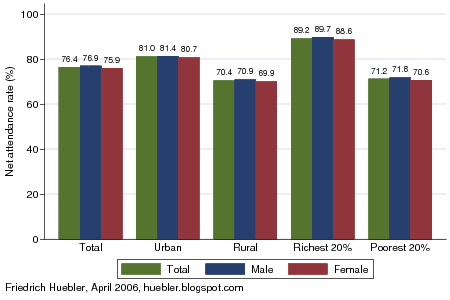
Bolivia is not close to the Millennium Development Goal (MDG) of universal primary education, but the goal of gender parity has been reached. With 75.9 percent, the primary school NAR of girls is almost the same as that of boys, 76.9 percent. The gender parity index (GPI), the ratio of female to male NAR, is 0.99. The NAR values are shown in the graph and table below.

Primary school net attendance rate, Bolivia 2003/04
Bar chart with total, male and female primary school net attendance rate in Bolivia, 2003/04
Data source: Bolivia 2003/04 DHS.

There is no gender disparity in Bolivia but disparities exist at other levels. Children in urban areas have a higher primary school NAR (81.0 percent) than children in rural areas (70.4 percent). Household wealth is strongly associated with school attendance. In the richest 20 percent of all households, 89.2 percent of all children of primary school age attend primary school. In the poorest 20 percent of all households, the primary school NAR is 71.2 percent. Raising attendance rates among the rural population and among the poor remains a challenge in Bolivia.

Primary school net attendance rate, Bolivia 2003/04

Total
NAR (%)
Male NAR (%)Female NAR (%)Difference
male- female
GPI
female/ male
Urban81.081.480.70.70.99
Rural70.470.969.91.00.99
Richest 20%89.289.788.61.00.99
Poorest 20%71.271.870.61.20.98
Total76.476.975.91.00.99
GPI: gender parity index. - Data source: Bolivia 2003/04 DHS.

Related articles
Friedrich Huebler, 16 April 2006 (edited 30 June 2006), Creative Commons License