21 January 2006

Household wealth and school attendance in Nigeria

In 2003, a Demographic and Health Survey (DHS) was conducted in Nigeria. This nationally representative household survey collected data on household characteristics, education, maternal and child health, family planning, and other indicators. The survey has no data on household income but with the information on assets owned by a household - for example, water supply, sanitation facilities, housing material, radio, telephone, refrigerator, bicycle, automobile, and livestock - it is possible to generate an index of relative household wealth (Filmer and Pritchett 2001). With this index, the link between wealth and the level of education of each household member can be analyzed.

The primary school age in Nigeria is 6 to 11 years and the secondary school age 12 to 17 years. As I showed in previous posts, the primary school net attendance rate (NAR) in Nigeria is 60.1% and the secondary school NAR 35.1%. This means that 60.1% (35.1%) of all children of primary (secondary) school age were attending primary (secondary) school at the time of the survey. Attendance rates are higher for boys compared to girls and for urban residents compared to rural residents. Household wealth is also strongly linked to school attendance, as the graph below demonstrates.

School attendance by age and household wealth, Nigeria 2003
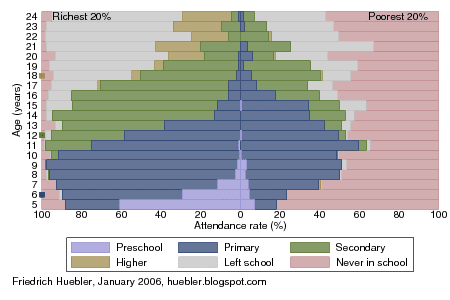
Graph with level of school attended by age and household wealth in Nigeria, 2003
Data source: Nigeria 2003 DHS.

The graph is constructed as two back-to-back bar graphs, similar to a population pyramid, but the two halves don't indicate age and sex but age and household wealth. The left half has the school attendance rates of the richest 20% of all households in Nigeria, as identified with the wealth index, and the right half the attendance rates of the poorest 20%. Only the population aged 5 to 24 years of age is covered because the DHS did not collected data on current school attendance for other ages. The population is divided into six groups:
  • currently attending preschool (purble bars)
  • currently attending primary school (blue bars)
  • currently attending secondary school (green bars)
  • currently attending higher education (brown bars)
  • attended school in the past but no longer in school (gray bars)
  • never attended school (red bars)
It is immediately obvious that only half of all children in the poorest 20% of the population ever attend school. In the richest 20%, on the other hand, almost everyone is currently in school or attended school in the past. For the population aged 5 to 24 years as a whole, 52.8% from the poorest quintile never attended school, while only 4.4% from the richest quintile never attended school.

In addition, those from wealthy households are much more likely to attend primary and secondary school at the proper age. The blue, green and brown markers along the left axis indicate the official starting ages of primary, secondary and tertiary education: 6, 12 and 18 years, respectively. Children from the poorest 20% of the population typically enter primary school much later than those from the richest 20% - if they attend school at all - and they typically do so without the advantage of having been in preschool first. Those from the richest households are also more likely to continue their education at the secondary or tertiary level.

In conclusion, to reach the Millennium Development Goal of universal primary education, Nigeria clearly has to target the poorest part of its population.

References: Filmer, Deon, and Lant H. Pritchett. 2001. Estimating wealth effects without expenditure data - or Tears: An application to educational enrollments in states of India. Demography 38 (1), February: 115-132.

Related articles:
- Primary school attendance in Nigeria
- Secondary school attendance in Nigeria
- Age and level of education in Nigeria
- Education data from household surveys


Friedrich Huebler, 21 January 2006, Creative Commons License

14 December 2005

Age and level of education in Nigeria

According to data from a Demographic and Health Survey (DHS) that was conducted in Nigeria in 2003, 60.1% of all children of primary school age were attending primary school at the time of the survey. Among children of secondary school age, 35.1% were attending secondary school.

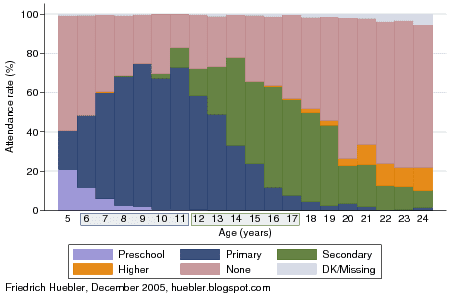
These primary and secondary school net attendance rates hide the fact that many children are in school at a level that is not appropriate for their age. In Nigeria, children often enter school at an advanced age and leave school well past the official graduation age. The primary school age in Nigeria is 6 to 11 years and the secondary school age 12 to 17 years. The graph below indicates the level of school attended for all Nigerians between 5 and 24 years of age. The data from the 2003 DHS survey reveals that a small percentage of Nigerians are still in primary school when they are already 20 years old. Secondary school attendance continues past 24 years of age, the highest age for which the DHS has data on current school attendance.

Level of school attended by age, Nigeria 2003
Bar chart with level of school attended by age in Nigeria, 2003
Data source: Nigeria 2003 DHS.

Only 36.6% of all 6-year-olds were attending primary school at the time of the survey. Primary school attendance reaches its peak between 9 and 11 years of age, when around 72% of all children are in primary school. At 17 years, the official graduation age from secondary school, 7.8% of all children were still in primary school.

Among 12-year-olds, only 13.9% were attending secondary school, with other children just beginning to attend primary school. Secondary school attendance reaches its peak at 16 years of age, when 51.3% of all children are in secondary school. At 24 years, 8.7% of the population were still in secondary school.

Delayed entry into the education system is a problem that exists in many other African countries. One indicator of this is that gross enrollment rates exceed net enrollment rates by a large margin in most of Sub-Saharan Africa. The repercussions of starting school late can be severe: such children are more likely to drop out from school and to enter the labor market with limited qualifications, reducing their potential to live productive lives. At the national level, having a less educated population makes it more difficult for countries to escape from poverty. Nigeria is therefore among the countries that are struggling to reach the Millennium Development Goals of universal primary education and eradication of extreme poverty and hunger.

Related articles:
- Primary school attendance in Nigeria
- Secondary school attendance in Nigeria
- Household wealth and school attendance in Nigeria
- Primary school gross and net enrollment
- Education data from household surveys


Friedrich Huebler, 14 December 2005 (edited 21 January 2006), Creative Commons License

16 November 2005

Secondary school attendance in Nigeria

Nigeria is the country with the largest population in Africa, estimated at 130 million in 2005. The most recent education data for Nigeria was collected in a Demographic and Health Survey (DHS) in 2003. 60.1% of all children of primary school age were attending primary school at the time of the survey.

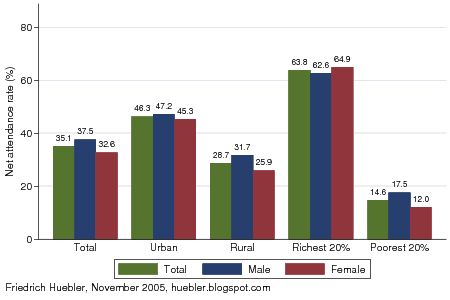
Far fewer children continue their education at the secondary level. The official secondary school age in Nigeria is 12 to 17 years and 35.1% of the children in this age group were in secondary school according to the DHS. For boys the secondary school net attendance rate (NAR) was 37.5% and for girls it was 32.6%.

Secondary school net attendance rate, Nigeria 2003
Bar chart with total, male and female secondary school net attendance rate in Nigeria, 2003
Data source: Nigeria 2003 DHS.

The attendance rate is strongly linked to household wealth and area of residence. 63.8% of children from the richest 20% of all households were in secondary school, compared to only 14.6% of children from the poorest 20% of all households. The secondary school NAR in urban areas was 46.3% and in rural areas it was 28.7%.

At the country level, the secondary school NAR of girls was 4.9% below the male NAR. This gender disparity is a result of lower attendance rates among girls in rural areas and in poor households. In urban Nigeria, the difference between male and female attendance rates was 1.9% and the gender parity index (GPI, the ratio of female to male NAR) was close to 1, in rural Nigeria the difference was 5.8% and the GPI was 0.82. In the poorest households the gender gap was 5.5% but in the richest household the gap was reversed: the NAR of girls was 2.3% above the NAR of boys. To reach the Millennium Development Goal of gender parity, education policy has to target poor rural residents.

Secondary school net attendance rate, Nigeria 2003

Total
NAR (%)
Male NAR (%)Female NAR (%)Difference
male- female
GPI
female/ male
Urban46.347.245.31.90.96
Rural28.731.725.95.80.82
Richest 20%63.862.664.9-2.31.04
Poorest 20%14.617.512.05.50.69
Total35.137.532.64.90.87
GPI: gender parity index. - Data source: Nigeria 2003 DHS.

Related articles:
- Primary school attendance in Nigeria
- Age and level of education in Nigeria
- Household wealth and school attendance in Nigeria


Friedrich Huebler, 16 November 2005 (edited 21 January 2006), Creative Commons License

06 November 2005

Guide to creating maps with Stata (archived version)

As of 31 August 2012, this document is no longer maintained and has been replaced by a new guide to creating maps with Stata. The archived version of the guide is only of interest to users of Stata 8, who will find instructions below. All users of Stata 9 or later versions are advised to follow the new guide. Please change your links to the new guide: http://huebler.blogspot.ca/2012/08/stata-maps.html.


The graphs and maps on this site are created with the Stata statistical package. This article describes how to make maps like those showing Millennium Development Goal regions and UNICEF regions in Stata from a shapefile.

Shapefiles store geographic features and related information and were developed by ESRI for its ArcGIS line of software. The shapefile format is used by many other programs and maps in this format can be downloaded from various sites on the Internet. Another common map format is the MapInfo Interchange Format for use with the MapInfo software. Shapefile data is usually stored in a set of three files (.shp, .shx, .dbf), while MapInfo data is stored in two files (.mif, .mid). Some sources for shapefiles and other data are listed on the website of the U.S. Centers for Disease Control and Prevention (CDC) under "Resources for Creating Public Health Maps." The CDC itself provides shapefiles for all countries with administrative boundaries down to the state level. Please note that these shapefiles are not in the public domain and are intended for use with the CDC's Epi Info software only. Other sources of shapefiles can be found with a Google search.

This guide is divided into two parts. Read part 1 if you have Stata 9 or 10 and part 2 if you have Stata 8. The creation of maps is not supported in older versions of Stata.


Part 1: Creating maps with Stata 9 or 10

To create a map with Stata 9 or 10 you need the following software.
  • Stata version 9.2 or newer.
  • spmap: Stata module for drawing thematic maps, by Maurizio Pisati. Install in Stata with the command "ssc install spmap".
  • shp2dta: Stata module for converting shapefiles to Stata format, by Kevin Crow. Install in Stata with the command "ssc install shp2dta".
  • Shapefile: For the example in this guide, download world_adm0.zip (646 KB), a shapefile that contains the boundaries of all countries of the world.
Step 1: Convert shapefile to Stata format
  • Unzip world_adm0.zip to a folder that is visible to Stata. The archive contains three files called world_adm0.dbf, world_adm0.shp, and world_adm0.shx.
  • Start Stata and run this command:
    shp2dta using world_adm0, data(world-d) coor(world-c) genid(id)
    Two new files will be created: world-d.dta (with the country names and other information) and world-c.dta (with the coordinates of the country boundaries). If you plan to superimpose labels on a map, for example country names, you should run the following command instead, which will add centroid coordinates to the file world-d.dta:
    shp2dta using world_adm0, data(world-d) coor(world-c) genid(id) genc(c)
    Please refer to the spmap documentation to learn more about labels because they are not covered in this guide.
  • The DBF, SHP, and SHX files can be deleted.
Some shapefiles are not compatible with the shp2dta command and Stata will abort the conversion with an error message. If this is the case, you can use a combination of two other programs, shp2mif and mif2dta. These programs are explained in the instructions for Stata 8 (see Step 1 and Step 2 in part 2 of this guide).

Step 2: Draw map in Stata
  • Open world-d.dta in Stata.
  • The file contains no country-specific data that could be used for this example so we will create a variable with the length of each country's name. The Stata command for this is:
    generate length = length(NAME)
  • Draw a map that indicates the length of all country names with this command:
    spmap length using "world-c.dta", id(id)
    Be patient because spmap is slow if a map contains many features.
  • The default map is monochrome, it shows Antarctica, the legend is too small and the legend values are arranged from high to low. We can draw a second map without Antarctica, with a blue palette, and with a bigger legend with values arranged from low to high:
    spmap length using "world-c.dta" if NAME!="Antarctica", id(id) fcolor(Blues) legend(symy(*2) symx(*2) size(*2)) legorder(lohi)
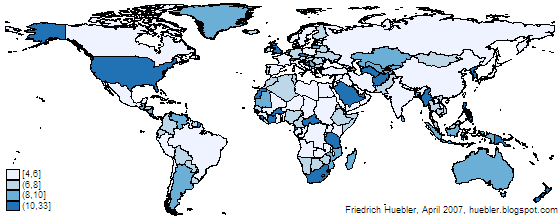
You now have the map below. Darker colors indicate longer names, ranging from 4 letters (for example Cuba and Iraq) to 33 letters (Falkland Islands (Islas Malvinas)). To customize the map further, please read the Stata help file for spmap.

Map created with spmap in Stata: length of country names
Example map created with spmap in Stata

The instructions above can be used to convert any shapefile to Stata format. If you have maps in MapInfo format you have to use another program called mif2dta that is described in part 2 of this guide.


Part 2: Creating maps with Stata 8

To create a map with Stata 8 you need the following software.
  • Stata version 8.2.
  • tmap: Stata module for thematic mapping by Maurizio Pisati. Install in Stata with the command "ssc install tmap".
  • mif2dta: Stata module for converting files from MapInfo to Stata format, also by Maurizio Pisati. Install in Stata with the command "ssc install mif2dta".
  • SHP2MIF: DOS program for converting shapefiles to MapInfo format. Go to the the website of RouteWare and click on "SHP2MIF (135 Kb)" under the heading "Converters" to get ishp2mif.zip.
  • Shapefile: For the example in this guide, download world_adm0.zip (646 KB), a shapefile that contains the boundaries of all countries of the world.
Step 1: Convert shapefile to MapInfo format
  • Unzip ishp2mif.zip. The archive contains three files, among them SHP2MIF.EXE.
  • Unzip world_adm0.zip to the same folder as SHP2MIF.EXE. The archive contains three files called world_adm0.dbf, world_adm0.shp, and world_adm0.shx.
  • Open a DOS command window: Windows Start menu - Run - "command" - OK.
  • Change the path in the command window to the folder that contains SHP2MIF.EXE and the three map files. Use the DOS command "cd" to change the path.
  • SHP2MIF works best with short file names in the 8.3 format (name up to 8 characters, extension up to 3 characters). Rename the map files with this DOS command:
    rename world_adm0.* world.*
    The map files are now called world.dbf, world.shp, and world.shx.
  • Convert the maps to MapInfo format by typing "shp2mif world" in the DOS command window. This produces two new files: WORLD.MID and WORLD.MIF.
  • Close the DOS command window.
  • The DBF, SHP and SHX files can be deleted.
Step 2: Convert MapInfo files to Stata format
  • Move the MIF and MID files to a folder that is visible to Stata.
  • Start Stata and run this command:
    mif2dta world, genid(id)
    Two new files will be created: world-Coordinates.dta (with the country boundaries) and world-Database.dta (with the country names and other information). If you plan to superimpose labels on a map, for example country names, you should run the following command instead, which will add centroid coordinates to the file world-Database.dta:
    mif2dta world, genid(id) genc(c)
    Please refer to the tmap documentation to learn more about labels because they are not covered in this guide.
  • The MIF and MID files can be deleted.
Step 3: Draw map in Stata
  • Open world-Database.dta in Stata.
  • The file contains no country-specific data that could be used for this example so we will create a variable with the length of each country's name. The Stata command for this is:
    generate length = length(name)
  • Draw a map that indicates the length of all country names with this command:
    tmap choropleth length, map(world-Coordinates.dta) id(id)
    Be patient because tmap is slow if a map contains many features.
  • The default map is monochrome, it shows Antarctica and the legend is too small. We can draw a second map without Antarctica, with a blue palette, and with a bigger legend:
    tmap choropleth length if name!="Antarctica", map(world-Coordinates.dta) id(id) palette(Blues) legsize(2)
  • To reduce the margins, display the graph again and set the margins to zero:
    graph display, margins(zero)
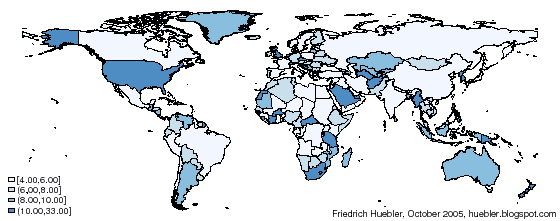
You now have the map below. Darker colors indicate longer names, ranging from 4 letters (for example Cuba and Iraq) to 33 letters (Falkland Islands (Islas Malvinas)). To customize the map further, please read the Stata help file for tmap and the tmap user's guide by Maurizio Pisati. The user's guide and additional tmap files can be downloaded in Stata with the commands "ssc describe tmap" and "net get tmap".

Map created with tmap in Stata: length of country names
Example map created with tmap in Stata

The instructions above can be used to convert any shapefile to Stata format. If you have maps in MapInfo format you can skip step 1 of the instructions and start with step 2.


Related articles
External linksFriedrich Huebler, 6 November 2005 (edited 31 August 2012), Creative Commons License
Permanent URL: http://huebler.blogspot.com/2005/11/creating-maps-with-stata.html

31 October 2005

Primary school attendance in Nigeria

Nigeria is one of UNICEF's 25 priority countries for girls' education. In the year 2005, the population of Nigeria is estimated to be 130 million, which makes it the most populous country in Africa. 22 million children are 6 to 11 years old, the official primary school age in Nigeria.

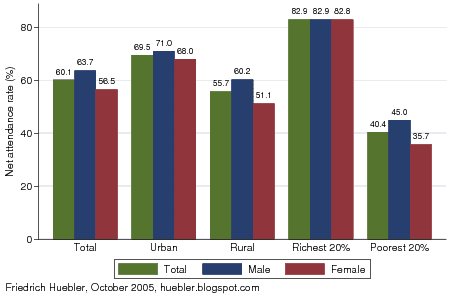
The most recent data on school attendance in Nigeria comes from a Demographic and Health Survey (DHS) that was conducted in 2003. 60.1% of all children of primary school age were attending primary school at the time of the survey. Boys had a higher net attendance rate (NAR) than girls, with 63.7% compared to 56.5% for girls.

Primary school net attendance rate, Nigeria 2003
Bar chart with total, male and female primary school net attendance rate in Nigeria, 2003
Data source: Nigeria 2003 DHS.

Children in urban areas had a higher primary NAR (69.5%) than children in rural areas (55.7%). The disparity between children from the richest and poorest households was even greater. In the richest 20% of all households, 82.9% of all children of primary school age attended primary school. In the poorest 20% of all households only two out of five children were in school (primary NAR 40.4%).

A comparison of the male and female NAR reveals that there was no gender disparity in the richest households. In urban areas, the difference between male and female NAR was also relatively small, with a gender gap of just 3.1%. In rural areas and among the poorest 20% of all households, girls were far less likely to attend school than boys; in both cases, the primary NAR of girls was about 9% below that of boys.

Primary school net attendance rate, Nigeria 2003

Total
NAR (%)
Male NAR (%)Female NAR (%)Difference
male- female
GPI
female/ male
Urban69.571.068.03.10.96
Rural55.760.251.19.00.85
Richest 20%82.982.982.80.11.00
Poorest 20%40.445.035.79.30.79
Total60.163.756.57.20.89
GPI: gender parity index. - Data source: Nigeria 2003 DHS.

Related articles:
- Secondary school attendance in Nigeria
- Age and level of education in Nigeria
- Household wealth and school attendance in Nigeria


Friedrich Huebler, 31 October 2005 (edited 21 January 2006), Creative Commons License