Goal 2 of the
United Nations Millennium Development Goals (MDG) is to "ensure that, by 2015, children everywhere, boys and girls alike, will be able to complete a full course of primary schooling." This site has published data for several indicators that are related to this goal, among them the
primary school net enrollment ratio (NER). In countries where children begin their education at the official primary school entrance age and graduate at the official graduation age, the primary NER is a good indicator of primary school completion. If many children in a country enter school late or if repetition rates are high, on the other hand, the primary NER underestimates the participation of children in the education system. The primary completion rate has been suggested by the
World Bank as a better indicator for progress toward MDG 2.
Definition: "The primary completion rate is the ratio of the total number of students successfully completing (or graduating from) the last year of primary school in a given year to the total number of children of official graduation age in the population." (United Nations Development Group. 2003.
Indicators for monitoring the Millennium Development Goals: Definitions, rationale, concepts and sources. New York: United Nations.)
- Primary completion rate = Number of primary school graduates / Number of children of primary school graduation age
The
UNESCO Institute for Statistics (UIS) publishes a proxy indicator for the primary completion rate under the name "gross intake rate to the last grade of primary". In the
Global Education Digest 2005, this indicator is defined as follows: "Total number of new entrants in the last grade of primary education, regardless of age, expressed as a percentage of the population of the theoretical entrance age to the last grade." The number of new entrants is the total number of children in the last grade of primary school minus the number of repeaters.
- Gross intake rate to last grade of primary = (Number of children in last primary grade – Number of repeaters) / Number of children of entrance age to last primary grade
While the calculation methods of the World Bank and UNESCO are different, they yield similar values. The World Bank publishes its estimates for the primary completion rate in the
World Development Indicators database. UNESCO's estimates are published in the
Global Education Digest 2005. The World Bank has data for 169 countries and the UNESCO Institute for Statistics for 166 countries. In the analysis that follows I refer to data from the UIS because the reported values are on average more recent than the values published by the World Bank.
The map below indicates the primary completion rate in each country for which data was available. The top group includes all countries with a primary completion rate at or above 90 percent. The primary completion rate can have values above 100 percent, which can be a symptom of late entry, grade repetition, or of an enrollment push at some point in the past, perhaps as a consequence of a school enrollment campaign. In the UIS database, 38 countries have values above 100 percent but in the long run the primary completion rate can be expected to stabilize at 100 percent.
Primary completion rate, 2002/2003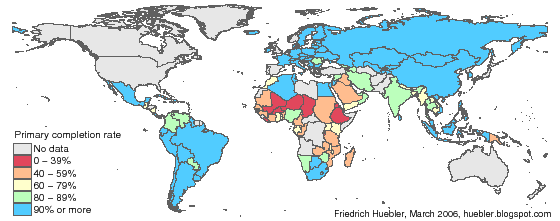 Data source: UNESCO Institute for Statistics (UIS). 2005. Global Education Digest 2005. Montreal: UIS.
In ten countries, all in sub-Saharan Africa, the primary completion rate is below 40 percent: Burkina Faso, Burundi, Chad, Djibouti, Eritrea, Ethiopia, Guinea-Bissau, Liberia, Mali, and Niger. In 19 countries, the primary completion rate is between 40 and 59 percent, in 20 it is between 60 and 79 percent, and in 26 countries it is between 80 and 89 percent. 91 countries have primary completion rates at or above 90 percent.
The global average for the primary completion rate is 84.5 percent (see the table below). Boys (86.4 percent) are more likely to complete their primary education than girls (82.3 percent). When countries are grouped by
UNICEF region, the highest primary completion rates are observed in industrialized countries (100.5 percent), Latin America and the Caribbean (97.2 percent), East Asia and the Pacific (96.6 percent), and in Eastern Europe and the Commonwealth of Independent States (93.8 percent). Countries in these regions have already reached or are close to the goal of universal primary education.
Lower primary completion rates are observed in Eastern and Southern Africa (59.5 percent), West and Central Africa (64.8 percent), the Middle East and North Africa (75.4 percent), and South Asia (81.6 percent). The biggest gender disparity exists in West and Central Africa, where the primary completion rate of boys is 14.6 percent above that of girls. High gender gaps also exist in Eastern and Southern Africa (7.6 percent), the Middle East and North Africa (7.5 percent), and South Asia (6.3 percent). Latin America and the Caribbean is the only region where girls are more likely to complete primary education than boys, but the gap is relatively small (2.6 percent).
Primary completion rate, 2002/03| Region | Primary completion rate (%)
|
| Male | Female | Total |
| East Asia, Pacific | 96.6 | 96.6 | 96.6 |
| Eastern and Southern Africa | 63.3 | 55.7 | 59.5 |
| Eastern Europe, CIS | 96.7 | 95.4 | 93.8 |
| Industrialized countries | 100.7 | 100.7 | 100.5 |
| Latin America, Caribbean | 95.9 | 98.5 | 97.2 |
| Middle East, North Africa | 79.0 | 71.5 | 75.4 |
| South Asia | 84.6 | 78.3 | 81.6 |
| West and Central Africa | 72.0 | 57.4 | 64.8 |
| World | 86.4 | 82.3 | 84.5 |
Data source: UNESCO Institute for Statistics (UIS). 2005. Global Education Digest 2005. Montreal: UIS.
Note: Regional values are weighted by each country's population of primary school age.Friedrich Huebler, 27 March 2006, Creative Commons License